
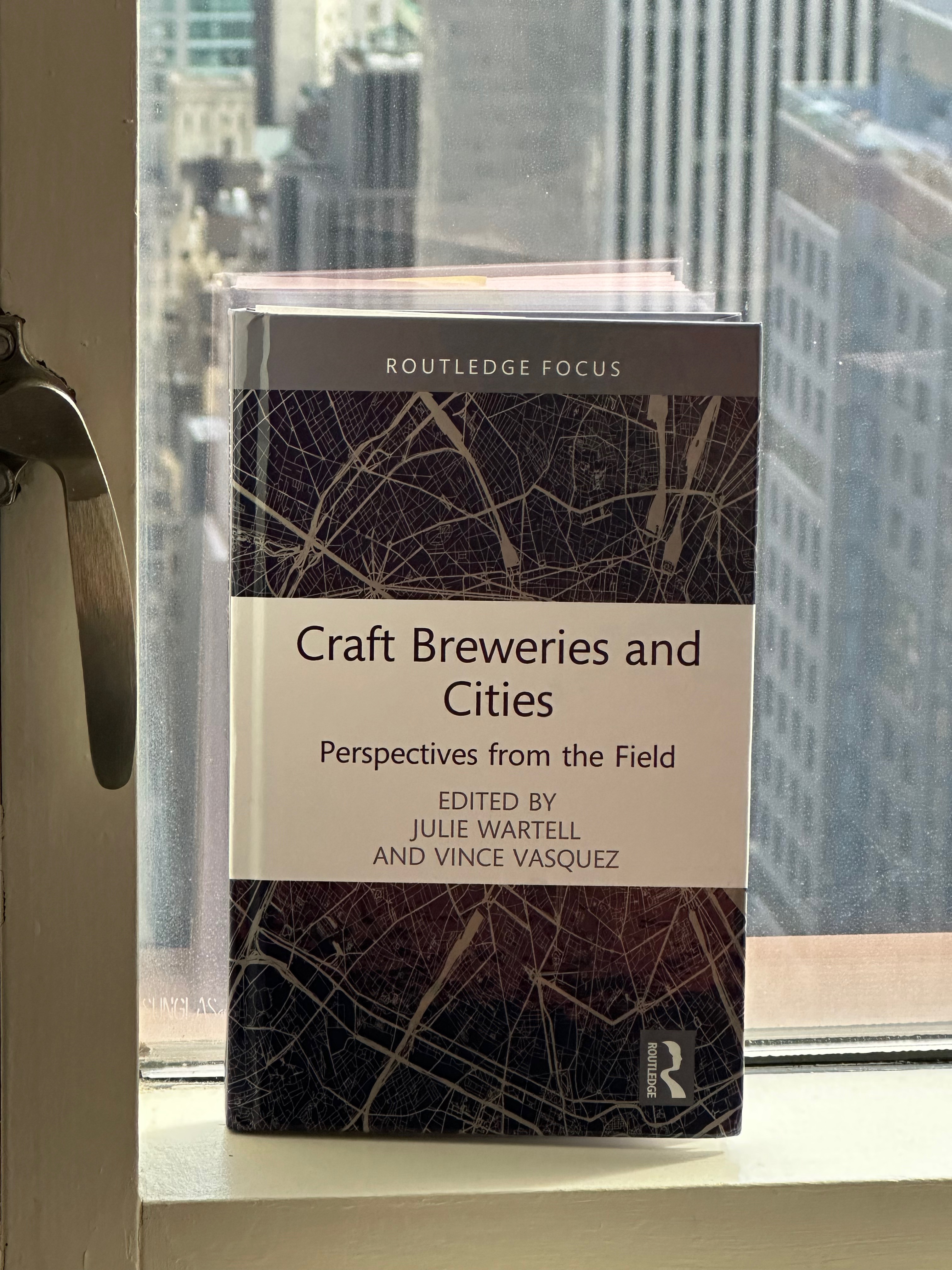
During 2022 we took on a project to write a chapter about craft beer tourism for a multi-disciplinary college textbook. We did interviews and we read dissertations from all around the world. The fact that this is a field of study was as fascinating as the theories. Although we ourselves are experienced travelers who nearly always fit in craft brewery visits as we wander, we are not involved in academia – I hadn’t needed to make proper footnotes since writing a paper involved corrections with White-Out – so we had not witnessed the growth of craft beer related research in the social sciences.
Some of the research we read is informative and intriguing. Since the whole brewing world is changing rapidly, a few of the earlier studies seem a little quaint. But it’s fascinating to see what’s getting the attention of the world’s beer-appreciating grad students and professors.
Now the book is out. That’s Craft Breweries and Cities: Perspectives from the Field. Since most of our friends and readers are clearly not teaching or taking college courses, we don’t expect anyone in our circle to buy a textbook. (And we don’t get royalties, so there’s no pressure on us to sell the book.) That makes talking about it all the more appealing. And so we shall, at a meeting of the Bay Area Brewers Guild November 7 and at a book chat at Russian River Brewery on the 8th, at 5:30 pm, open to the public, no cover, buy yourself a beer and join us in the tasting room.
When we accepted the challenge, our first inclination was to find examples of the impact of beer tourism. We wanted numbers. The example that came to mind was the annual release of Pliny the Younger, since Russian River Brewing and the Sonoma County economic development folks have been tracking the fiscal side of that impact for years now. We enjoyed retelling that story based on interviews with Natalie Cilurzo and members of the team working for the county to interpret the data.
RRBC’s Pliny the Younger is an unusual phenomenon, both for the fame of the release and for the years of data collection, but we found others trying to measure economic impacts in their communities and there are some write-ups of these efforts. This led us to a look at how people are building “ale trails,” “passports” or “beer cities” to get visitors out to explore small breweries. and how they are tracking the impacts of their efforts.
The more elaborate trails appear to mostly be funded by Destination Marketing Organizations with names like “Visit Yakima Valley,” charged with increasing hotel tax revenues in a particular region, city or state. Some breweries are forming their own trail nonprofits or doing it through regional guilds. Some just provide lists, some suggest itineraries, some offer discounts and some have gamification with rewards for getting around to all the locals.
The most practical report we found about beverage trails is not paywalled and can be found at https://aese.psu.edu/nercrd/publications/other-published-resources/beer-trails-in-pa.pdf One takeaway there is that Pennsylvania is not just supporting beer tourism, but research about how it works.
Overall, a big takeway about beer tourists is that we seem to index very highly as “cultural omnivores,” wanting the most interesting authentic local goodies, be it that amazing breakfast spot the brewer mentioned, hearing a band the locals love, going to a farmers market or an interesting winery — “anything but the most commonplace.” Yep.
Our friend, coauthor and editor Julie Wartell will be joining us Wednesday at 5:30 at RRBC. Julie’s discipline is mapping, more specifically crime maps . Her research has shown that while some kinds of bars are a crime magnet, craft breweries and their satellite taprooms are not.
Julie has also assured us that she can talk about other stories she edited. From demographics and economics to zoning and gentrification, people are taking some deep looks at impacts of breweries on their communities.
We hope that if you are in the area, you can join us at RRBC Windsor, at 5:30 pm on Wednesday November 8.
In more somber news, we are holding Jeff Botz in our memories this week. We just lost one of the nicest and kindest members of the industry. In recent years he co-founded and usually staffed The Cooler in San Leandro, bringing cheer and beer intelligence to customers at that carefully curated craft beer bar.
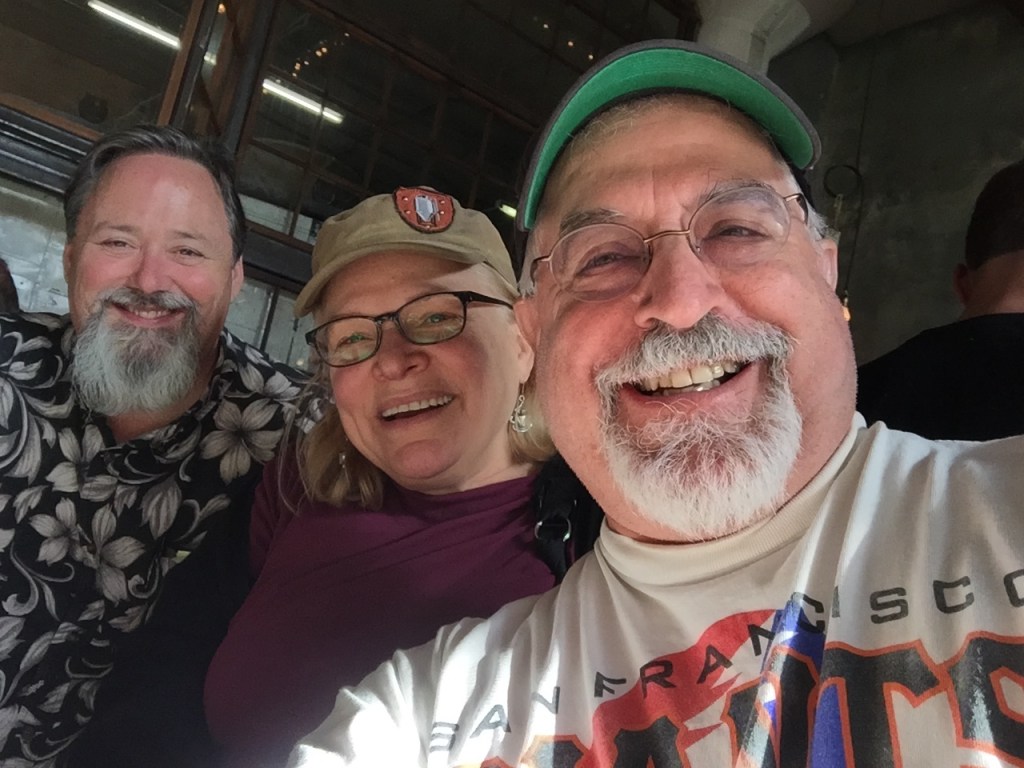
That’s Jeff on the left, the two of us on the right, all happy to be hanging out together a few years back. We’ll be raising a glass to him several times in the days to come, no doubt.
 Beer by BART
Love this! Thanks for diving in to academic research! 🙂
LikeLiked by 1 person